
A commercial maker based on artificial intelligence has emerged as one of the most discussed instruments of digital advertisements. The need to create low-cost, fast, and quality commercial work has risen as brands, creators and marketers vie against each other online. Rather than spending all the time and costs on using costly studios, time-consuming editing processes, and multifaceted software to create finished video commercials, the current AI technology makes it feasible to create refined video commercials within a fraction of the time.
The blog will assist you in knowing how these AI systems are operated, how they have become significant in the current advertising environment, and why they are now being considered as a significant element in the digital marketing education. It is not aimed at advocating one or the other tool, but intending to describe the concept, process, and practical value of them.
What Does an AI Commercial Maker Mean?
An AI commercial creator is a computerized platform that relies on artificial intelligence to aid in the creation of brief video advertisements, sponsored content, or commercials. Rather than manually performing all the video creation tasks, AI automates several tasks including:
- Script generation
- Scene planning
- Voiceover creation
- Editing and transitions
- Captioning and formatting
- Visual enhancements
The outcome is an efficient workflow in which the user has the ability to manage the creativity and the AI does the routine or technical tasks. These tools can teach students, digital marketers, small business owners, and content creators a lot about modern advertising since they expose them to the extent to which much of media production has become automated.
The reason AI is changing the process of making commercials.
The process of automation of video production is not accidental – it is the way technology is transforming communication. These are key learning points regarding this change:
1. Faster Production Cycles
The conventional video production process is the planning process, scripting process, shooting process, editing process, and revisions. AI shortens this time to a minimum. What used to be done in days is now done in minutes. This can be applied by students learning about digital media to gain knowledge of the efficiency of production in the real world.
2. High Accessibility
In the past, professional commercials were only available to well-funded brands. However, AI-driven creation enables small enterprises, freelancers and educators to experiment without having technical know-how or extensive financial resources.
3. Multiplatform Adaptability
AI applications can automatically downsize or reformat videos on other platforms like YouTube, Instagram, Tik Tok, or websites. This will assist learners to learn the relevance of platform-specific content strategy.
4. Creative Augmentation
AI does not substitute creativity, but rather it helps in the process. AI can be utilized by writers, designers, and marketers to brainstorm and visualize ideas and accelerate the process of creative execution.
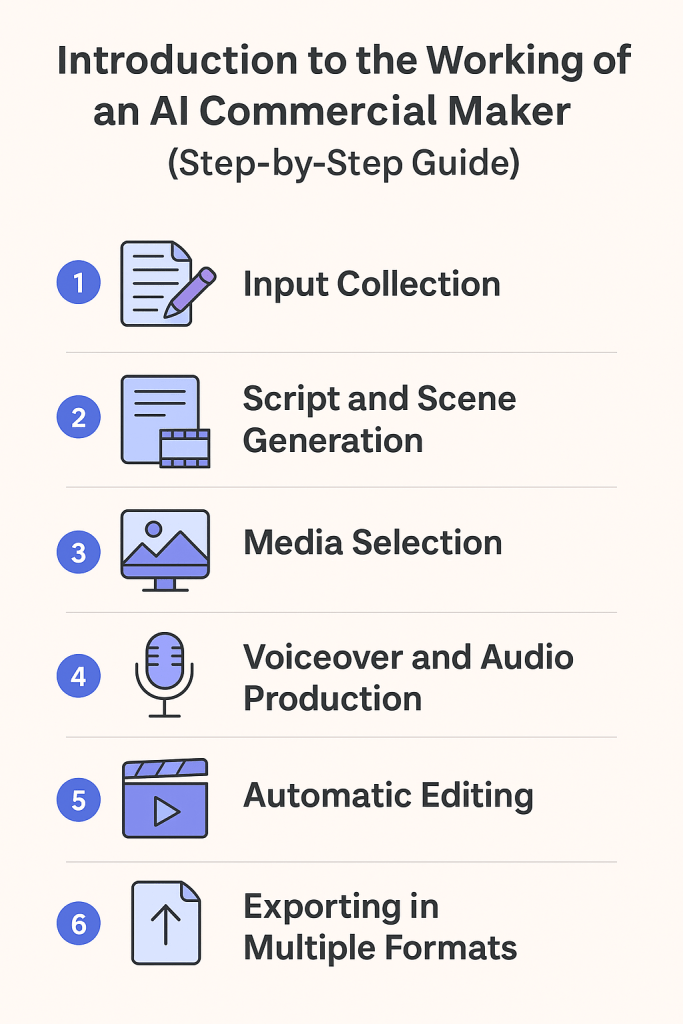
Introduction to the Working of an AI Commercial Maker (Step-by-Step Guide).
To ensure that this guide is informative and educational, a basic break-down on the way such tools tend to work is as follows:
1. Input Collection
The user enters the basic information such as:
- Product or topic
- Goal of the advertisement
- Audience type
- Length of the video
This assists the AI to develop an appropriate outline.
2. Script and Scene Generation
The AI generates an approximate script and recommends a scene flow. These scripts are normally manipulable and the user can exercise their creativity.
3. Media Selection
AI selects video stock, images, animation, or drawings that are aligned to the script. They can be changed or customized by the user.
4. Voice Over and Audio Production.
The majority of AI tools provide a variety of voice styles and tones, as well as different languages. This assists the learners to know about the audio branding and the significance of sound in commercials.
5. Automatic Editing
The transitions, text overlays, timing options, and color grading are automatically done to give it a polished appearance.
6. Exporting Multiple Formats.
As soon as the video is prepared, it can be downloaded in various sizes and resolutions based on the platform to be served.
Pros of applying an AI commercial creator to education.
Although most individuals consider AI tools as a form of shortcut, they can be of great educational importance, particularly to students studying marketing, media studies, and creating digital content. The knowledge about the functioning of an ai commercial maker reveals the users to the main ideas in storytelling, branding, and modern communication.
1. How to learn Marketing Principles by practice.
The commercial tools that are AI-based will help users navigate through the key processes of creating an advertisement, including:
- Structuring a message
- Knowing the psychology of the audience.
- Highlighting key benefits
- Having visual hierarchy.
- Crafting strong CTAs
These exercises assist students and amateurs in real-life marketing reasoning, as, in fact, they are constructing a commercial as opposed to theorizing about it.
2. Knowing Visual Communication.
Advertising involves visual storytelling. An artificial intelligent content producer assists the user in seeing the layout of scenes, the dynamic of the pace or rhythm, and the visuals used to convey information. Many learners discover:
- How color impacts emotion
- The significance of a smooth transition.
- The role of background music
- Text overlays through the direction of attention.
These points are necessary to create media literacy in digital age.
3. Promoting Critical thinking and trial.
Ai generated content is never flawless the first time round, this is a plus to the learners. It allows room to evaluate:
- What makes a message clearer
- Improving the flow of the storyline.
- What visuals are more professional to you?
- What type of tone will be most effective with various audiences?
This experimentation develops problem solving skills and increases creativity in thinking.
4. Minimising Technical Barriers.
Accessibility is one of the largest educational advantages. Students do not require expensive cameras, editing knowledge, and software to understand the structure of ads. The technical friction is eliminated by AI tools, which allow learners to concentrate on concepts, creativity, and strategy.
How to make an effective ad with an AI commercial maker: Best Practices.
In order to maximize the use of these tools, one should observe some of the best practices. These make sure that every output is both attractive to the eye and content and conveyive.
1. Start With a Clear Objective
Learners ought to define: Before producing anything, they should define:
- What is the message?
- Who is the audience?
- What is the course of action to be taken by viewers?
The clear goal makes the last commercial more goal-oriented and effective.
2. Never Stop Improving the AI-Written Script.
AI scripts are an excellent place to start, and then human refinement is needed. Users should check for:
- Accuracy
- Emotional tone
- Relevance
- Brand consistency
- Clarity
- A good script is the staple of any good commercial.
3. Apply Visuals that Underline the Message.
Although AI can select stock clips, they are to be reviewed. Good visuals:
- Match the narrative
- Connect emotionally
- Maintain consistency
- Use no cliched or inappropriate imagery.
This is one step that enables users to know how storytelling and design are related.
4. Striking a Balance between Innovativeness and Plainness.
The most effective commercials are not complicated but easy to remember. Artificial intelligence tools can be rather excessive in effects and transitions. Users are advised to cut off all unnecessary information and make the video clean, interesting, and comprehensible.
5. Maximize on Multiple Platforms.
There are best practices of each platform. For example:
- Tik Tok: Vertical and rapid videos.
- YouTube: Horizontal and long videos.
- Instagram: High-quality videos that are one-minute long.
- Videos: Informative videos and brand-oriented videos.
The process of resizing becomes simple with the help of AI tools; however, the user should still comprehend the importance of formatting.
Top AI Commercial Ads Maker Tools List
To make the readers comprehend the mechanism of automated video production, the educational list of the 5 best tools that are frequently used to learn and to experiment with commercial production is provided here. Both of the tools provide various options, which allow students, amateurs, and marketers to learn visual communication, the structure of scripts and the flow of advertising.
1. Tagshop AI (UGC-Based Commercial Generator)
Tagshop AI is an AI-based UGC-based video generation. Its automatic editing, scripting and organization of scenes make it applicable in learning how real-life advertisements are made. It assists beginners in learning viewer friendly commercial styles that are a common practice in social media marketing.
2. InVideo
InVideo has numerous ad-style video templates. It educates users on how scenes, transitions, on-screen text, and background audio can be used in unison to make successful commercials.
3. Pictory
Pictory creates long-form or video content based on scripts. This assists the learners to appreciate script-to-visual transformation and the use of narration to aid in storytelling in commercial-like videos.
4. Veed IO
VEED.io has AI subtitles, cleanup options, and basic editing options. It is useful to learn clarity, pacing, and accessibility, which are the key elements of a successful commercial work.
5. FlexClip
FlexClip is a drag-and-drop video editor that presents the user with the principles of sequencing videos, branding videos, and visual design, which are perfect to use in the educational practice.
Ethical Issues When engaging an AI Commercial Maker.
With the increasing use of AI, one should exercise caution when applying it, particularly in learning institutions.
1. Advertising Authenticity.
Students need to be taught that although AI can assist in production, the message has to be factual and truthful. False advertising would damage confidence and reputation.
2. Observing Copyright and Licensing.
Still, despite numerous AI tools offering the stock assets, learners are to check:
- Asset licenses
- Usage rights
- Copyright rules
This develops consciousness on digital ethics and responsible media usage.
3. Not to be too dependent on Automation.
AI can be a useful helper, not the substitute of creativity. Instead of leaving AI to do all the work, users are supposed to concentrate on creating their own ideas, visual reasoning, and communication techniques.
The Future of AI in Business Production.
In the coming few years, there will be a booming AI-assisted content creation. The current knowledge of these tools will equip the user with future of marketing. The improvements to be expected in the future are:
- More realistic voiceovers
- State-of-the-art motion graphics automation.
- Personalized ad generation
- Realistic virtual actors
- Smart brand-style modification.
Learners who acquire such systems early have a competitive edge in the digital media fields.
AI Commercial Maker Vs Traditional Commercial Creation.
In order to appreciate the worth and drawbacks of contemporary AI instruments, it is necessary to contrast them with the traditional commercial production. This assists the students and the beginners to develop a realistic and balanced view.
1. Cost and Resource Requirements.
Conventional commercial production usually needs:
- A filming crew
- Camera equipment
- Studio space
- Professional editors
- Voice artists
- Designers and animators
This configuration may be costly and therefore small businesses or students will not be able to experiment.
Conversely, an artificial intelligence business producer lowers the cost of entry significantly. It offers in-built images, automatic editing, voiceover, templates, and pre-prepared resources. Although it cannot substitute full-scale productions, it will enable the learners to rehearse and learn the building blocks of an advert without the burden of financial limitations.
2. Efficiency in Time and Workflow.
Conventional advertisements involve planning, shooting and numerous edits. This is useful in training students on discipline and project management- but it is time consuming.
AI tools offer:
- Instant drafts
- Ready-to-use templates
- Automated editing
- Fast revisions
This quick workflow enables novices to experiment on ideas quicker and investigate various ideas, before making a final design choice.
3. Creative Control
The conventional production puts the entire lighting, performance, scripting and visuals under its control. Moviemakers make everything by themselves.
Although flexible, AI systems work within the framework of the templates and existing stock assets. This is a valuable lesson that will be learned by the learners: technology adds to creativity but it cannot fully substitute the ability of human imagination and storytelling.
4. Skill Development
Conventional commercial production constructions:
- Camera skills
- Lighting knowledge
- Scene direction
- Sound recording
- Post-production editing
AI tools build:
- Storytelling
- Branding logic
- Content strategy
- Editing fundamentals
- Audience understanding
The two methods are both educational and integrating the two methods is the most balanced way of learning.
Practical Implementations of an AI Business Maker.
Even though this is not an advertisement, it is helpful to see where AI tools are applicable in real-life situations. These are illustrations of their usefulness in contemporary communication.
1. Media Assignments and Classroom Projects.
The students are able to make mini video campaigns, product advertisements, or storytelling projects without having to use professional equipment. This improves digital literacy and creativity.
2. Small Business Education
Those entrepreneurs who study digital marketing can apply AI-based technology to comprehend the way messages, images, and target audiences combine in an advertisement.
3. Corporate Training and Internal Communication.
Onboarding or updates are often conducted using short videos by companies. Artificial intelligence applications make learners perceive the difference between internal messaging and external advertising.
4. Social Media Marketing Practice.
Artificial intelligence can be used to enable novices to trial ad formats on various platforms and gain an idea of how content differs on social networks.
5. Essentials in Creative Skill Building.
Pacing, script flow, and visual composition can be studied by any person who is learning video production by using AI-generated drafts.
FAQs
1. Are AI business tools substituting human editors?
No. They accelerate the working process and do repeat jobs, yet human creativity and judgment cannot be neglected.
2. Is it possible to use these tools without experience?
Yes. The majority of the systems are user friendly and offer step by step instruction.
3. Do AI-created commercials work with professional campaigns?
They are effective on simple, quick and social media advertisements. In the case of high budget advertising, conventional production could still be favored.
4. Do these tools educate actual marketing concepts?
Absolutely. Users get to know about messaging, structure, storytelling, audience targeting, and visual communication.
5. Is it morally right to advertise with AI?
Yes, provided the message is truthful, the assets are licensed appropriately, and transparency whereby is required.
Final Conclusion
The Importance of Learning an AI Commercial Maker in the Modern World.
The world of advertising develops so fast, and being familiar with these tools is now a good quality, not an option any more. A commercial maker of artificial intelligence enables learners, designers, and marketers to experiment with the basics of online advertising without having to use costly resources or without having high technical expertise.
More so, these tools promote experimentation, creativity and critical thinking. They expose the operation of the modern media, the creation of the audience interaction, and the effectiveness of visual narration.
Using AI tools along with human creativity, learners may develop more robust communication skills, comprehend the behavior of the market, and be ready to the future of creating digital content.
Author Bio
Written by William
I’m William, A digital marketing specialist and AI video strategist & Writer with over 6 years of experience in online advertising and content creation. I focus on video marketing, AI-driven storytelling, and brand communication. My goal is to help small businesses, creators, and educators embrace AI tools to simplify ad creation, boost engagement, and achieve creative success in the digital era.
 AI Avatar Photo Blog
Leave a comment